
Iran: The First War With Live Odds
Prediction markets give war a live score with side bets. Iran is the first prediction market war.

Polymarket has 246 active markets on Iran and over $1 billion traded on Iran-related markets. These markets are incredibly granular: not just questions like “will US strike Iran” but the specific count of ships running through the Strait of Hormuz, whether the Shah’s son will return to Iran, whether a ceasefire will be achieved by certain dates, whether Iran will strike Saudi Arabia and the UAE, and whether the nuclear option will be used (though this market was removed after pushback).
War is now broken into player props.
Sports betting took off when it went from “who wins the game” to micro-markets: player props, in-game lines, and live odds on every possession. That same decomposition has now happened to war, which has been broken into tradeable micro-events the way a basketball game was broken into “will Jokic record a triple double”.
When a journalist is the resolution source, they become the target.
Prediction markets resolve against a consensus of credible reporting. Reporters aren’t simply covering the war, they are the resolution mechanism for contracts with millions of dollars riding on them. In March, a Polymarket contract asked whether Iran struck Israel on a specific date, and more than 90% of the betting volume came after the event itself, with traders fighting over whether a particular blast counted as a “strike” under the market’s rules.
A military correspondent for the Times of Israel reported that a missile had hit near Jerusalem, and his story was quoted in The Economist and other news sites. Traders who needed the story to read differently sent him death threats, demanding he change his reporting to say an intercepted projectile was responsible, which wouldn’t count as a strike under the contract’s resolution criteria. The more money that flows into these markets, the stronger the financial incentive to influence the reporting.
War Now Has Live Odds.
Wars have always moved prices. Oil spiked when Iraq invaded Kuwait, defense stocks jumped after 9/11, gold rallied during every Middle East escalation for fifty years. But those were indirect signals that required interpretation: you had to figure out what a $5 move in crude meant for the likelihood of a broader conflict, what a selloff in shipping companies implied about the Strait of Hormuz, what the VIX was actually telling you versus what cable news said it was telling you. You had to read between the lines, and between those lines, politicians could exaggerate, media organizations could editorialize, and intelligence agencies could plant stories that served their interests.
Prediction markets skip the interpretation entirely. There is a contract on Polymarket asking which countries Iran will retaliate against, with separate yes/no prices for Israel, UAE, and Saudi Arabia. You don’t need to reverse-engineer what Brent crude is telling you about the probability of a military strike; there’s a number that updates in real time.
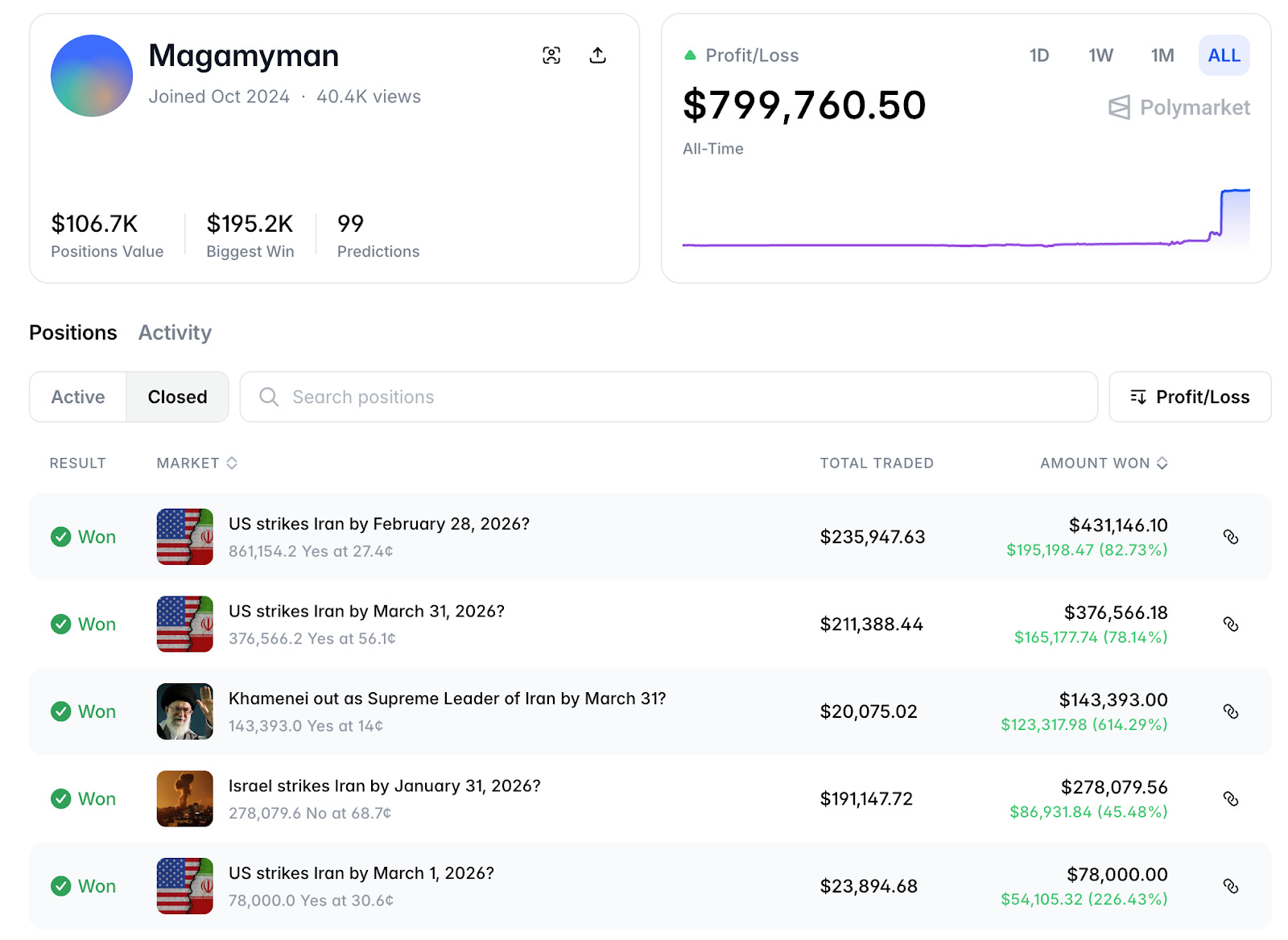
A trader made nearly $800,000 by accurately predicting when the US and Israel would strike Iran. There’s a financial incentive for people to make life-changing amounts of money by predicting the truth.
The Evolution of Media in War
Iran is the first war you can refresh every minute. Marshall McLuhan’s most famous idea is that the medium is the message: we obsess over the content on the screen or the page and miss that the screen or the page itself is what’s reshaping how we think, feel, and relate to each other. The content is a distraction; the form is what changes you. Television didn’t just show Americans the Vietnam War; it turned a distant jungle conflict into the first “living room war”: something that felt domestic and visceral, that you processed with your body while sitting on a couch after dinner. McLuhan noticed that the same war story could provoke patriotic anger in a newspaper but empathy for the victims on television. The same facts through a different medium can evoke a completely different emotional response.
With the Iran war, the medium is the money. And money is a fundamentally different kind of medium than a photograph, broadcast, or tweet. It doesn’t show you suffering, it doesn’t show you anything at all. It gives you a number. When you look at Polymarket and see that the probability of a ceasefire by March 31 is 24%, you are not feeling anything about the people living under bombardment, you are processing a probability, evaluating whether 24% is too high or too low, maybe thinking about placing a trade, or maybe refreshing the page the way you’d refresh a score during a playoff game. Most people watching these odds aren’t betting, they’re spectating. Watching these numbers move is engaging the way a stock ticker is engaging or a live score is engaging, not engaging the way a photograph of a bombed hospital is engaging.
Last week, Polymarket made that experience physical: they opened a pop-up bar in Washington DC called “The Situation Room”.


Eighty screens, a six-foot globe, Bloomberg terminals, flight radar, live prediction market odds on the walls, and they described it as “a sports bar, but just for situation monitoring.” War is now entertainment: watching live odds change when a leader announces a military strike is not so far from watching a wide receiver score an unexpected touchdown.
Neil Postman spent the 1980s warning that television would turn all serious public discourse into entertainment, framing it as a contest between Orwell and Huxley: Orwell feared the government would ban books and suppress truth, while Huxley feared nobody would need to ban anything because the public would be so drowned in information and amusement that truth would become irrelevant, lost in a sea of noise. Postman thought Huxley was winning, and he was right.
Television showed you what war looked like; Vietnam was the first television war. Social media made everyone a war correspondent; Ukraine was the first TikTok war. Prediction markets make war a game with a live score; Iran is the first prediction market war.